|
|

|

|

|

|

|
Signal Conditioning Solutions
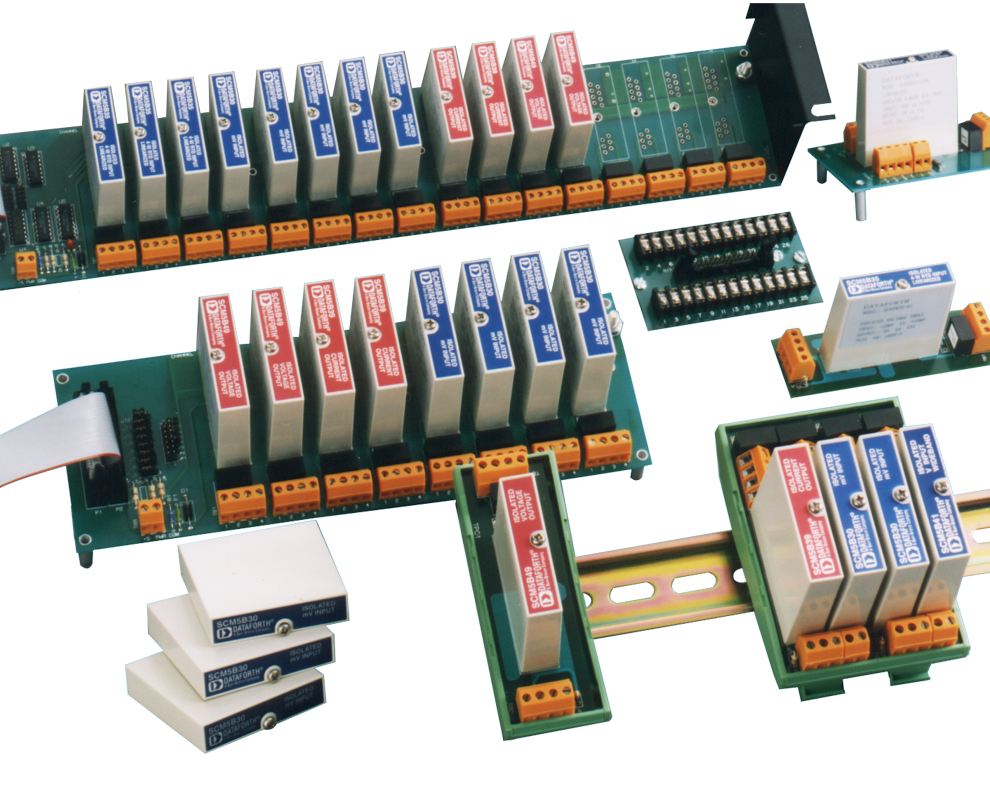
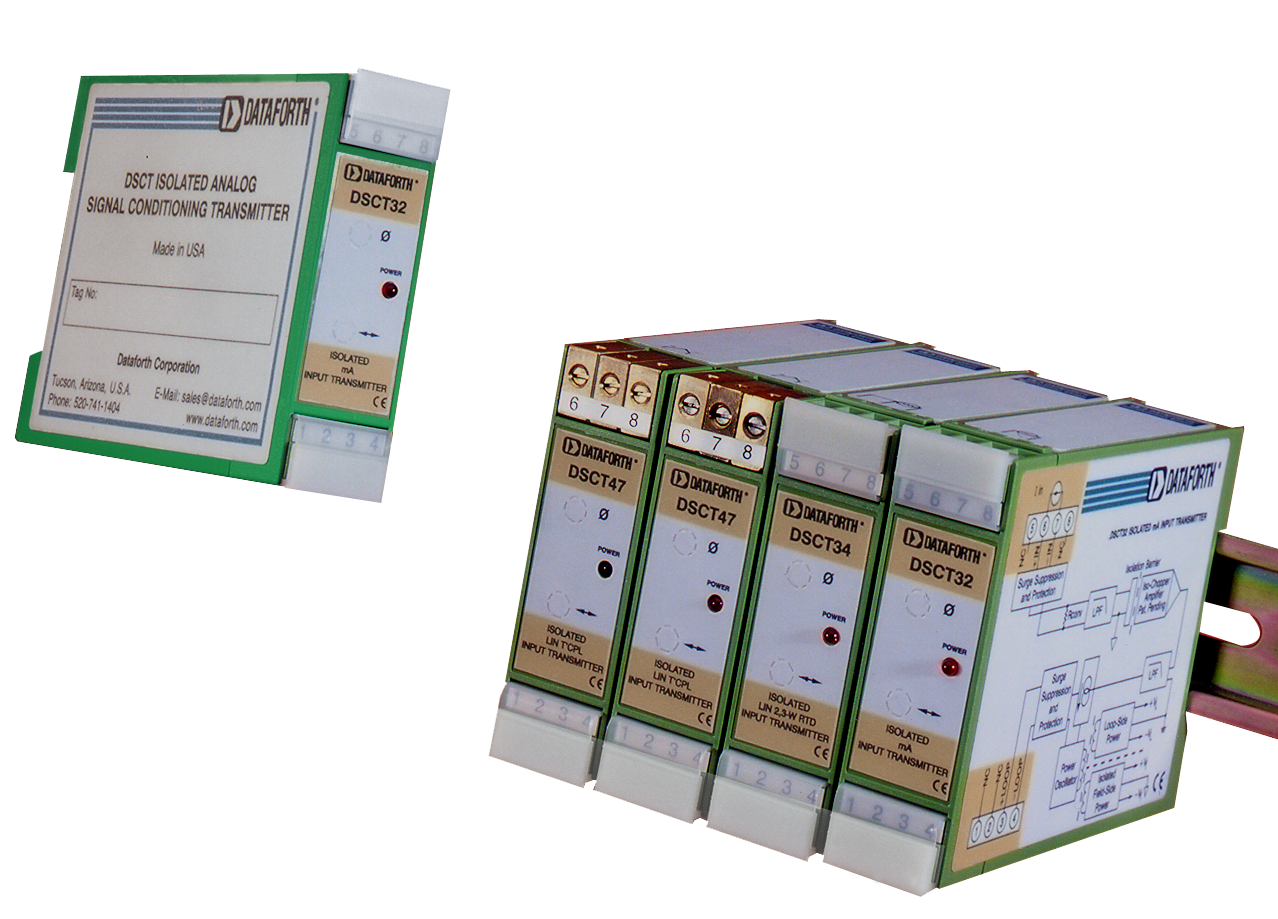
New DSCA DIN rail isolated analog signal conditioning modules offer high performance at low cost
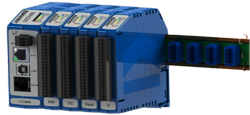
Dataforth Corporation announces the introduction of its new DSCA
signal conditioning modules for DIN rail mount applications.
These isolated analog signal conditioning modules bring a new
standard of performance to the data acquisition market at a price
lower than most competitors. Combining the best features of the
Company's "5B" and "7B" signal conditioning products, and adding
additional capability, the DSCA signal conditioners offer electrical
specifications that are usually found only in much higher cost "instrument
class" devices.
|

|
|
|

|
The
DSCA signal conditioners were developed after an extensive survey
of customer requirements. Important areas of improved performance
for the general market include accuracy, linearity, conformity error,
and protection against accidental connection of line voltages and
transient events. The DSCA signal conditioner family consists of
360 models which accept millivolt, volt, milliamp, RTD, thermocouple,
potentiometer, strain gage, DC LVDT, frequency, and two-wire transmitter
inputs. Voltage input conditioners accept signals from +/-10mV
to +/-40V, and current input conditioners accept signals of 0 to 20mA
and 4 to 20mA. Accepted thermocouple types are type J, K, T, E, R,
S, B, and N. RTDs can be 2- or 3-wire, types Pt 100, Pt 200, Pt 500,
Pt 1000, or 120 ohm nickel.
Potentiometer inputs can range from 0-100 ohms to 0-10k ohms.
Strain gage transducers may have a resistance range of 100 ohms through
10k ohms, with sensitivities of 2mV/V or 3mV/V. The General Purpose
module provides excitation and accepts input ranges from +/-1V to
+/-10V. Frequency input signals can be TTL or zero crossing with ranges
of 0-500Hz to 0-100kHz. The two-wire transmitter module provides loop
power and accepts a 4-20mA input signal. An additional 13 models will
be offered soon to provide isolated field-side current and voltage
outputs. Current output ranges will be 0 to 20, 4 to 20, and +/-20
milliamp, and voltage output ranges will be 0 to 5V, 0 to 10V, +/-5V,
and +/-10V with up to 50mA drive capability. Accuracy rating
is +/-0.05%.
This figure includes nonlinearity, hysteresis, and repeatability.
Linearity is +/-0.01%. The modules have excellent stability over time
and do not require recalibration. However, multi-turn potentiometers
are accessible to the user and provide non-interactive zero and span
settings adjustable up to +/-5% for situations requiring fine tuning.
Linearization of thermocouple signals is accomplished by a hardware
implemented piece-wise approximation technique. The difference between
the sensor non-linearity and the linearization provided by the DSCA
module is called the conformity error.
DSCA modules use 10 segments to correct non-linearity which results
in conformity errors as low as +/-0.015% span. Cold junction compensation
error for thermocouple inputs is +/-0.01°C/°C. Signal bandwidth is
3Hz for most models; the exceptions being 100Hz for current input
and two-wire transmitter interface modules, and 1kHz for strain gage
and DC LVDT modules. Output noise is as low as 250µVrms on the low
bandwidth models. Each DSCA module isolates the field-side input or
output signal with a galvanic isolation barrier rated at 1500Vrms
continuous.
True 3-way isolation is used throughout the family; providing
isolation barriers between signal input and output, power supply to
field-side circuitry, and power supply to system-side circuitry. Common-mode
rejection is 160dB, and by incorporating a five-pole filter, normal-mode
rejection is 85dB at 60Hz and 80dB at 50Hz. Dataforth DSCA modules
are unique in that all input, output, and power supply lines are protected
against high level voltages and currents. This protects expensive
data acquisition equipment and allows the DSCA modules to be operated
in harsh electrical environments. Specifically, special protection
circuits protect input lines up to 240VAC, output lines against continuous
short to ground, and power input lines against power reversal. All
input and output terminals are protected against transient events
as defined by ANSI/IEEE C37.90.1-1989.
Power supply requirements are standard control values with
most of the models accepting any voltage between 12V to 32VDC. All
modules are designed to be "hot-swappable", or to be plugged in or
out without turning off power. A power-on LED is displayed on the
face of each module. Typical current is only 20mA, with the strain
gage, DC LVDT, two-wire transmitter, frequency, and output modules
requiring slightly more. For ease of system assembly and reconfiguration,
all signal and power lines are secured to the module using screw terminals
integral with pluggable terminal blocks. These terminal blocks are
equipped with pull tabs which also function as protective covers for
the screw terminals.
The case dimensions are 75mm x 22.5mm x 105mm. All modules mount to
the standard DIN EN 50022 35mm rail. The operating and storage
temperature range is -40C to +80C, and relative humidity can be
up to 95% noncondensing. The modules meet CE requirements, and CSA
and FM approvals are pending.
Go
directly to our DSCA family in our
Signal Conditioning Products Catalog.
Data acquisition. Signal conditioning. Signal conditioners. Thermocouple.
Strain gage. Data loggers. Data logging. PC-based data acquisition.
5B signal conditioning. Dataforth provides all data acquisition and
signal conditioning solutions.
|
|

|
|
|