|
|

|

|

|

|

|
Signal Conditioning Solutions
New DIN-Rail Isolated Signal Conditioning Module
for Measuring True RMS
Dataforth Corporation, Tucson, Arizona announces the introduction
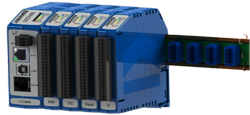
of its new DSCA33, a DIN rail mounted
isolated signal conditioning module for measuring True
RMS values of input signals.
Each DSCA33 True RMS input module provides a single channel of
AC input which is converted to its True RMS DC value, filtered,
isolated, amplified, and converted to a standard process voltage
or current output.
RMS, or Root Mean Square, is a principle measurement of an AC signal.
In practical terms, it is the equivalent DC signal that produces the
same amount of heat in the same load. Therefore, it directly relates
to signal power. For purely sinusoidal signals, the RMS value is the
familiar peak amplitude divided by the square root of two. However,
for signals comprised either of harmonics or of noncoherent content,
this expression becomes increasingly invalid as the harmonic content
or noncoherency increases.
|

|
|
|

|
Typically this is given in terms of a waveform's Crest Factor (C.F.),
which is the ratio of its peak value to RMS value. Crest factors start
at one for square waves and generally increase for more "pointed"
signals. True RMS conversion reduces the dependency on sinusoidal
purity, thus allowing accurate measurement of signals ranging from
pulses to complex nonperiodic waveforms. Previously, industrial
users requiring true RMS conversion were forced to use 'brick' type
converters, in-house designs, or those not well suited for typical
industrial conditions.
The RMS conversion core circuit used in the DSCA33 is identical
to those used in high-end digital voltmeters costing thousands of
dollars. In addition, the module provides 1500V continuous protection
to computer-side equipment and personnel. The product family consists
of 35 AC-coupled modules, which accept either voltage or current inputs.
Ranges cover 100mVrms to 300Vrms for the voltage models and 1Arms
to 5Arms for the current models. All modules operate at frequencies
of 45 to 1kHz (standard range), and will also operate from 45Hz to
20kHz (extended range). System-side module outputs are 0-5Vdc, 0-10Vdc,
0-1mA, 0-20mA, or 4-20mA, depending on model.
Measurement accuracy (comprised of calibration accuracy, linearity,
repeatability, and hysteresis) is rated at ±0.25% for sinusoidal input
(50/60Hz calibration frequency), with an additional ±0.25% of reading
over the 45-1kHz standard operating frequency range. For extended
frequency range operation, only ±0.75% additional error is added to
the total measurement uncertainty. In addition, Crest Factor error
adds only ±0.05% for Crest Factors up to 2, and ±0.40% for signals
with Crest Factors up to 5. Moreover, output ripple and noise
is only 0.025% span RMS, greatly surpassing typical industrial converters
having ripple and noise 10 to 40 times larger. For voltage input
models, input impedance is a constant 1M ohm in parallel with
less than 100pF of capacitance.
Continuous overload protection is provided for up to 480V (Peak
AC +DC), and transient protection is provided in accordance with ANSI/IEEE
C37.90.1-1989. For current input models, the input resistance
is a constant 0.10 ohm (1A input) or 0.05 ohm (5A input), thus incurring
only a quarter of a volt burden on the source at 5A input current.
Up to 10Arms continuous and 50Arms (for one second) can be withstood
for the current input modules. All models operate on wide range power
of 15 to 30VDC. For current output models, a dedicated loop
supply is provided in the module. Rated operating temperature is
from -40° C to +80° C, and all modules meet the requirements of EN50081-1
(radiated/conducted emissions) and EN50082-1 (ESD/RF/EFT
immunity).
Go
directly to our DSCA33 family in our
Signal Conditioning Products Catalog.
Data acquisition. Signal conditioning. Signal conditioners. Thermocouple.
Strain gage. Data loggers. Data logging. PC-based data acquisition.
5B signal conditioning. Dataforth provides all data acquisition and
signal conditioning solutions.
|
|

|
|
|